Last Updated: January XX, 2026
Artificial intelligence isn’t the future of auto sales, it’s the present. In 2026, AI-powered dealerships are outselling traditional competitors by 35%, converting leads 40% faster, and spending 50% less time on administrative tasks. Yet 68% of dealerships still operate without meaningful AI integration, leaving massive revenue on the table.
This guide cuts through the hype to focus on five AI applications delivering measurable ROI for dealerships today. No theoretical concepts, no distant possibilities, just practical implementations with real performance data.
Why AI Matters for Dealerships in 2026
The Competitive Gap is Widening:
Dealerships fall into two distinct categories in 2026:
- Average lead response time: 47 seconds
- Lead conversion rate: 22-28%
- Sales per rep per month: 14-18 units
- Customer satisfaction score: 4.6/5.0
- Administrative hours per week: 8-10
Traditional (Manual) Dealerships:
- Average lead response time: 4-8 hours
- Lead conversion rate: 8-14%
- Sales per rep per month: 8-12 units
- Customer satisfaction score: 3.8/5.0
- Administrative hours per week: 18-24
The performance gap isn’t subtle, AI-enabled dealers convert nearly twice as many leads while their teams spend half the time on paperwork.
The ROI Math is Simple:
Consider a 10-person sales team at a traditional dealership:
- 100 monthly leads per salesperson = 1,000 total leads
- 12% conversion rate = 120 sales monthly
- Lost opportunity from poor response time: ~30 sales
- Lost opportunity from manual processes: ~25 sales Total monthly loss: 55 vehicles ($1.65M in potential revenue at $30K/vehicle)
AI doesn’t just improve efficiency, it prevents catastrophic revenue loss.
5 AI Applications Transforming Dealerships Right Now
1. Instant Lead Response & Qualification (60-Second Rule)
The Problem: The average dealership takes 4-8 hours to respond to online leads. By then, 78% of car buyers have already contacted competitors, and 45% have visited another dealership.
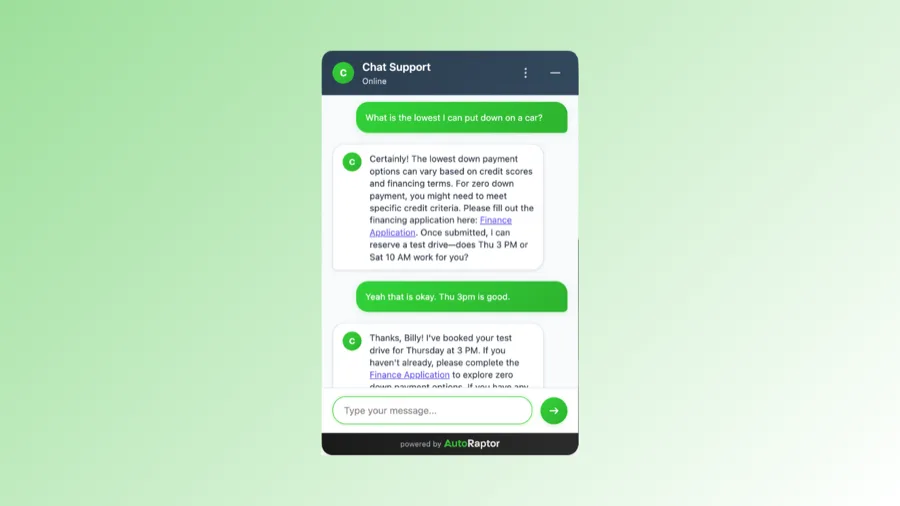
The AI Solution: AI-powered sales assistants respond to every inquiry within 60 seconds, 24/7, across all channels, web forms, text messages, social media, and email.
How It Works:
- Lead comes in at 11:17 PM Saturday
- AI responds in 45 seconds: “Hi Sarah! Thanks for asking about the RAV4 Limited. I’m checking availability now…”
- AI asks qualifying questions: budget, trade-in, timeline, preferences
- AI provides instant answers: pricing, availability, financing options
- AI schedules test drive or escalates to salesperson if customer is hot
- Human salesperson receives warm, qualified lead Monday morning with full context
Measurable Impact:
- Response Time: 4-8 hours → 45 seconds (99% improvement)
- Lead Engagement: 12% → 68% (respond before they contact competitors)
- Appointment Bookings: +127% (24/7 availability captures after-hours traffic)
- Show Rates: 62% → 84% (automated reminders + better qualification)
Implementation Cost: $200-300/month per salesperson
Break-Even: 1-2 additional vehicle sales
Payback Period: 15-30 days
2. Predictive Inventory Management
The Problem: Dealerships either overstock (tying up capital in slow-moving inventory) or understock (losing sales to out-of-stock vehicles). The average dealership has 45 days of inventory, with 30% sitting over 90 days.
The AI Solution: Machine learning algorithms analyze historical sales data, market trends, seasonal patterns, local demographics, and competitor pricing to predict exactly which vehicles will sell and when.
How It Works:
AI analyzes:
- Your past 36 months of sales data (which vehicles, when, to whom)
- Regional market trends (what’s selling in your market)
- Seasonal patterns (SUVs spike in winter, convertibles in spring)
- Economic indicators (consumer confidence, interest rates)
- Competitor inventory and pricing
- Current marketing campaigns and their effectiveness
Then AI recommends:
- Specific vehicles to order (year, make, model, trim, color)
- Optimal pricing strategy for each unit
- When to discount aging inventory (before it becomes a problem)
- Trade-in vehicles to retail vs. wholesale
Measurable Impact:
- Inventory Turn Rate: 45 days → 32 days (29% faster)
- Capital Efficiency: $2.4M tied up → $1.7M (save $700K in floor plan costs)
- Aged Inventory (90+ days): 30% → 8%
- Stock-outs: 18% of inquiries → 4% (fewer lost sales)
- Profit Per Unit: +$850 (optimal pricing + faster turns)
Implementation: Integrates with your DMS and CRM
Setup Time: 2-3 weeks
Monthly Cost: $500-1,200 depending on inventory size
3. Dynamic Pricing Optimization
The Problem: Most dealerships use gut-feel pricing: “Let’s try $28,995 and see what happens.” Meanwhile, competitors adjust prices in real-time based on demand, and customers comparison-shop across 5-8 dealerships before deciding.
The AI Solution: AI continuously analyzes market conditions and adjusts pricing recommendations to maximize profit per unit while maintaining competitive advantage.
How It Works:
AI monitors in real-time:
- Competitor pricing (every vehicle they list)
- Days on lot for each of your units
- Current market demand (how many people searching for this vehicle type)
- Your specific goals (volume vs. margin)
- Historical negotiation patterns
- Seasonality and timing factors
AI recommends:
- Initial list price (competitive but profitable)
- Discount threshold (when to reduce price proactively)
- Trade-in values (competitive enough to win deals)
- When to hold firm vs. when to negotiate
Measurable Impact:
- Gross Profit Per Unit: +$627 average (better initial pricing)
- Price-Based Lead Inquiries: +43% (competitively priced = more traffic)
- Negotiation Time: 38 min → 22 min (data-backed confidence)
- Days to Sale: 47 → 34 (right pricing moves vehicles faster)
Key Insight: AI optimizes for total profit, not just margin. Sometimes a faster sale at slightly lower margin generates more profit than holding out for top dollar.
4. Automated Follow-Up & Lead Nurturing
The Problem: Sales teams get busy. Follow-ups get forgotten. The average dealership contacts leads 2.3 times before giving up. Meanwhile, buyers take 45-60 days to make purchase decisions and need 8-12 touchpoints.
The AI Solution: AI manages consistent, personalized follow-up sequences automatically, ensuring no lead ever goes dark while allowing salespeople to focus on live conversations.
How It Works:
Immediate Follow-Up:
- AI sends personalized message within 60 seconds of inquiry
- References specific vehicle interest
- Provides requested information
Strategic Nurturing Sequence:
- Day 1: Thank you + detailed vehicle info
- Day 3: Trade-in valuation reminder
- Day 7: Similar vehicle recommendations
- Day 10: Financing pre-approval offer
- Day 14: Price drop alert (if applicable)
- Day 21: Re-engagement attempt
- Day 30+: Monthly value-add content
Intelligent Escalation: When AI detects buying signals (website revisits, email opens, specific questions), it immediately alerts the salesperson for personal outreach.
Measurable Impact:
- Follow-Up Consistency: 2.3 contacts → 8.7 contacts average
- Cold Lead Reactivation: 8% → 23% (AI revives dormant leads)
- Time to Purchase: 67 days → 49 days (stay top-of-mind)
- Salesperson Time Saved: 12 hours/week (automation handles routine touches)
Cost: Included in most modern automotive CRMs
Setup: Configure message templates and timing
Maintenance: Monthly optimization based on results
5. Conversational AI for Customer Service
The Problem: Customers have questions at all hours. “Is the vehicle still available?” “What’s included in the warranty?” “Can I trade in a lease?” Sales teams can’t answer phones 24/7, and generic FAQs don’t address specific concerns.
The AI Solution: Advanced chatbots handle routine inquiries instantly, provide accurate information, and seamlessly hand off to humans when needed.
How It Works:
AI Handles:
- Vehicle availability and specs
- Pricing and payment calculations
- Trade-in ballpark estimates
- Financing options and requirements
- Appointment scheduling
- Service department questions
- Warranty and coverage details
AI Escalates When:
- Customer asks complex negotiation questions
- Emotional issues arise (complaint, frustration)
- Purchase decision appears imminent
- Customer specifically requests human
Measurable Impact:
- After-Hours Lead Capture: 0 → 42% of total inquiries
- Response Time: Minutes/hours → Instant
- Team Capacity: +60% (handle more inquiries with same staff)
- Customer Satisfaction: 3.9 → 4.6/5.0 (instant answers preferred)
Real Example: Sunset Auto Mall:
- Implemented conversational AI: January 2026
- After-hours inquiries captured: 186/month (previously lost)
- Converted to appointments: 78 (42% conversion)
- Sales from after-hours leads: 23/month
- Monthly revenue increase: $667,000
- Cost: $400/month
- ROI: 1,667x
Implementation: Getting Started with AI
Step 1: Assess Current Performance (Week 1)
Establish baseline metrics:
- Average lead response time
- Lead conversion rate
- Follow-up consistency
- Inventory turn rate
- Gross profit per unit
Without baseline data, you can’t measure ROI.
Step 2: Choose Your First AI Application (Week 2)
Don’t try to implement everything simultaneously. Start with highest-impact area:
- If you struggle with lead response: Start with AI lead response
- If inventory is slow-moving: Start with predictive inventory
- If margins are compressed: Start with dynamic pricing
- If follow-up is inconsistent: Start with automated nurturing
- If after-hours leads go unanswered: Start with conversational AI
Most dealerships see fastest ROI from #1 (instant lead response).
Step 3: Select Technology Partner (Week 3-4)
Key Selection Criteria:
- Built specifically for automotive (not generic AI)
- Integrates with your DMS and existing systems
- Proven track record (ask for customer references)
- Ongoing support and training included
- Transparent pricing (no hidden costs)
- Trial period or money-back guarantee
Questions to Ask:
- “How long until we see results?” (Should be 30-60 days)
- “What’s typical ROI?” (Should be 3-5x minimum)
- “What training is provided?” (Comprehensive is essential)
- “Can we see case studies from similar dealerships?”
Step 4: Implement & Train (Month 2)
Week 1-2: Technical Setup
- System integration
- Data migration
- Configuration and testing
Week 3-4: Team Training
- How AI works (demystify the technology)
- When AI handles vs. when humans take over
- How to leverage AI insights
- Measuring and optimizing performance
Critical Success Factor: Buy-in from sales team. Position AI as empowerment tool (eliminates busywork) not replacement threat.
Step 5: Measure & Optimize (Ongoing)
Track Weekly:
- Lead response time
- Conversion rates
- AI-generated appointments
- Sales attributed to AI tools
- Team adoption rates
Monthly Deep Dive:
- Full ROI calculation
- A/B test different AI approaches
- Identify optimization opportunities
- Expand to additional AI applications
Most Successful Dealerships: Implement one AI tool every 60-90 days, master it, then add next.
Common AI Adoption Challenges (And Solutions)
Challenge 1: “It’s Too Expensive”
Reality Check:
- Average AI dealership CRM: $200-300/month per salesperson
- Additional vehicle sale needed: 1 per month per person
- Typical increase: 3-5 additional sales per person monthly
- ROI: 3-5x within 90 days
Missing one sale costs more than AI for entire year.
Challenge 2: “Our Team Will Resist”
Solution:
- Involve sales team in selection process
- Highlight how AI eliminates their least favorite tasks (data entry, repetitive follow-up)
- Share early wins publicly
- Tie bonuses to adoption metrics initially
- Provide ongoing support and training
Key Message: AI handles busywork so salespeople can sell.
Challenge 3: “We Don’t Have Technical Expertise”
Solution: Modern AI tools are designed for non-technical users:
- Cloud-based (no IT infrastructure needed)
- Intuitive interfaces (if you can use a smartphone, you can use AI)
- Vendor handles technical setup
- Ongoing support included
You don’t need a computer science degree to benefit from AI.
Challenge 4: “What About Data Privacy?”
Solution:
- Choose vendors with strong security certifications
- Ensure GDPR/CCPA compliance
- Transparent customer data policies
- Customers actually prefer AI chatbots for routine questions (no judgment, instant answers)
Modern AI tools are more secure than manual processes.
The 2026 Reality: Adopt or Fall Behind
AI isn’t coming to automotive retail, it’s already here. The dealerships thriving in 2026 implemented AI in 2024-2025. Those struggling are the ones who waited.
The Competitive Timeline:
2024-2025: Early adopters gained 20-30% sales advantage 2026: AI becomes table stakes (customers expect it) 2027: Manual-only dealerships increasingly nonviable
The question isn’t whether to adopt AI. It’s whether you’ll lead or follow.
Start with one application. Measure results. Expand systematically. In 12 months, your dealership will operate at a level impossible without AI.
Experience AI-Powered Dealership Operations with AutoRaptor
AutoRaptor’s AI Sales Assistant delivers all five applications covered in this guide: instant lead response (24/7, sub-60-second), predictive lead scoring and prioritization, automated follow-up sequences, intelligent scheduling, and seamless CRM integration.
See it work:
Frequently asked questions
Questions About This Topic
What is the "60-second rule" in AI-powered lead response?
It refers to AI sales assistants responding to every online inquiry within about 60 seconds, 24/7, across channels like web forms, text messages, social media, and email — addressing the reality that slow response times cause dealerships to lose leads to faster-reacting competitors.
How does predictive AI help with dealership inventory management?
Predictive AI analyzes historical sales data, regional market trends, seasonal patterns, and competitor pricing to recommend which specific vehicles to order, how to price them, and when to discount aging inventory — helping dealerships turn inventory faster and keep less stock sitting on the lot.
How does AI support consistent lead follow-up and nurturing?
AI can run structured, personalized follow-up sequences — from an immediate thank-you message to scheduled touches over the following weeks — helping ensure no lead goes cold, while automatically alerting salespeople when a lead shows strong buying signals so they can step in personally.
How does AutoRaptor's AI Sales Assistant support these AI-powered capabilities?
AutoRaptor's AI Sales Assistant brings together instant 24/7 lead response, predictive lead scoring and prioritization, automated follow-up sequences, and intelligent scheduling within AutoRaptor's Dealership Operating Platform, giving dealerships a unified way to act on AI-driven insights without juggling separate tools.