Key takeaways
- Definition: an automotive CRM (also called an auto dealer CRM or dealership CRM) is software that captures every sales lead, logs every call, text and email, and automates follow-up so no car buyer is missed.
- Speed still decides who gets the sale: In a late-2024 study of 1,700 dealerships, only 61% answered a web lead within 15 minutes, and 19% took more than an hour.
- Buyers move faster: the whole purchase now takes just under 14 hours, and 44% of new-car buyers combine online and in-store steps (Cox Automotive, 2026).
- Must-have features: lead management and routing, two-way texting, automated follow-up, AI lead response, DMS and inventory integration, desking, a full mobile app, and source-level reporting.
- CRM vs DMS: the CRM runs the sale up to the handshake; the DMS runs the deal, accounting and service afterward. Most dealers need both, connected.
- Cost: dealer CRMs are usually priced per rooftop, by user tier, or both. AutoRaptor plans scale from 3 to 5 users up to unlimited users.
- Choose by fit: independent and buy here, pay here (BHPH) dealers need fast setup, simple texting and credit tools; franchise groups need OEM lead feeds, multi-rooftop reporting and deep DMS integration.
What is an automotive CRM?
An automotive CRM is customer relationship management software built for car dealerships. It brings leads from your website, third-party marketplaces, OEM programs, phone calls and walk-ins into a single record per shopper, then tracks every interaction until the vehicle is sold, and afterward for service retention and repeat purchases.
General-purpose CRMs such as Salesforce or HubSpot can be configured to approximate this workflow, but only with significant customization. A purpose-built car dealer CRM ships with the automotive essentials already in place: ADF/XML lead parsing, vehicle-of-interest and trade-in fields, desking, credit applications, inventory matching and DMS synchronization.
In one sentence: a dealership CRM is the system that makes sure every lead gets a fast answer, a structured follow-up plan and an accountable owner on your sales team.
How dealers use a CRM day to day
- Capture: A lead arrives from any source and is matched against existing customers, so nobody re-types it.
- Route: Rules assign it to the right salesperson or BDC agent by store, brand, new or used, or round robin.
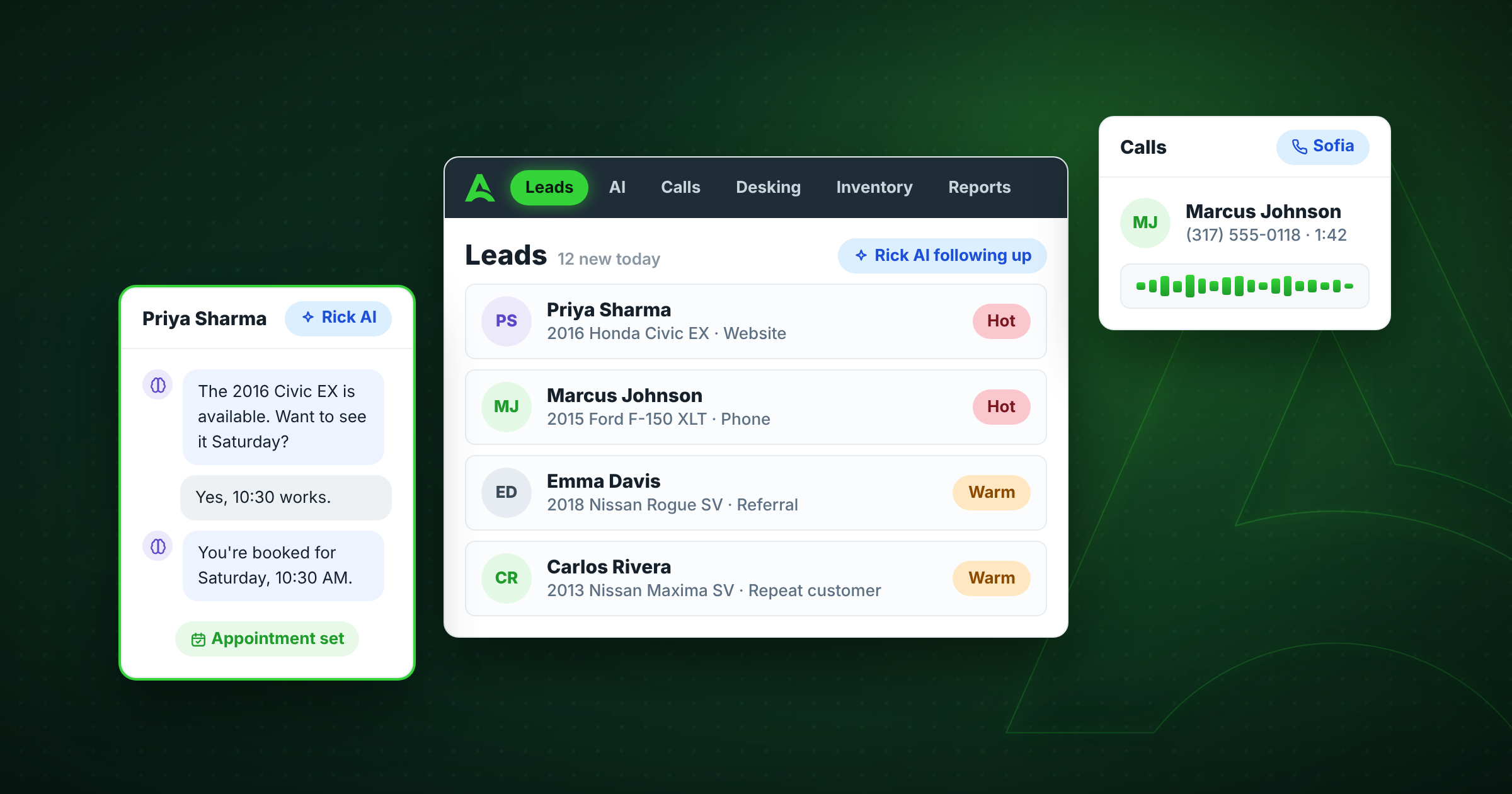
- Respond: An instant text or email goes out, and an AI assistant can reply after hours.
- Follow up: An action plan schedules calls, texts and emails across the next 30 to 90 days.
- Set and show: Appointments and test drives are booked, confirmed and tracked through to a show.
- Close and hand off: The deal moves into desking and then into the DMS.
- Retain: Service reminders, equity alerts and purchase-anniversary messages bring the customer back for the next vehicle.
Why dealerships need a CRM: what the data says
Dealers who respond first and follow up longest sell more cars, and a CRM is the only practical way to do both consistently. Three findings explain why running a store without one is getting more expensive.
- Response gaps are still wide. In the second half of 2024, DAS Technology tested lead response at 1,700 dealerships that were not its customers. 61% replied within 15 minutes, 19% took more than an hour, and 4% never replied (Dealership Guy). Of the replies, 74% left out a price quote and 90% didn't include multiple vehicle photos (DAS Technology).
- Buyers spend less time buying and expect an efficient process. Cox Automotive's 2025 Car Buyer Journey study, released in January 2026, surveyed 2,300 recent buyers. Total time spent buying fell to just under 14 hours, 44% of new-vehicle buyers combined online and in-person steps, and 76% of new-vehicle buyers were highly satisfied with the buying process, a record (Cox Automotive).
- AI is now part of car shopping. In the same study, 25% of new-vehicle buyers used AI tools while shopping (19% of all buyers), and 63% of dealers said investing in AI tools now is critical to success.
Shoppers do more research before they contact a store, expect a detailed reply within minutes, and reward dealerships that make buying quick. A CRM shows managers, in real time, whether the team is meeting that standard.
AutoRaptor data: 2026 lead response benchmark
Across 316 independent dealerships using AutoRaptor, leads from July 2025 to June 2026 closed at an average of 4.5% within 90 days. Leads from a dealership’s own channels closed far more often than marketplace leads. Referrals closed at 35.2%, repeat customers at 34.4% and walk-ins at 27.9%. Third-party providers ranged from 7.0% (Carsforsale.com) down to 1.0% (Facebook and CarZing). CarGurus sent the most leads, 167 per dealership per month, but closed at 2.4%. Because marketplace leads close at a fraction of the rate of referrals and walk-ins, fast and persistent follow-up on them makes the biggest difference.
Methodology: figures come from aggregated, anonymized CRM activity at 316 independent dealerships whose AutoRaptor agreements allow research use. A lead counts as sold if the customer bought within 90 days. The figures benchmark lead sources, not AutoRaptor’s performance. See the full lead source benchmark for every provider.
8 must-have features in a car dealer CRM
The best dealership CRMs do eight things well. If a vendor can't demonstrate all eight live with your own lead sources, keep evaluating.
| Feature | What good looks like | Ask the vendor |
| Lead management and routing | Parses ADF/XML and web-form leads from every source, removes duplicates, assigns by rules | "Show me a Cars.com lead arriving and being assigned." |
| Two-way texting | Texts from a dealership number, logged to the customer record, with opt-in compliance | "How do you handle TCPA opt-in and STOP replies?" |
| Automated follow-up | Action plans for new, aged, sold and lost leads; equity and service campaigns | "Can managers edit action plans without calling support?" |
| AI lead response | Answers and qualifies leads around the clock, books appointments, hands off to a person | "What does the AI say when it doesn't know an answer?" |
| DMS and inventory integration | Syncs customers, deals and live inventory in both directions | "Which DMS do you integrate with, and is it included?" |
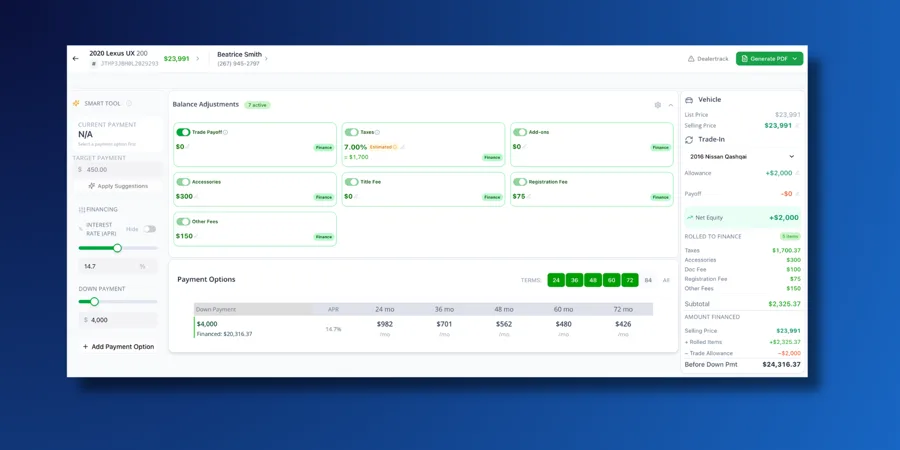
| Desking and credit | Payments, trade values and credit applications from inside the CRM | "Can a rep quote a payment from the phone?" |
| Mobile app | The full CRM on the phone, with VIN and driver's license scanning | "Can a rep work an up entirely from the lot?" |
| Reporting | Source ROI, response time, rep activity, appointment show rate, multi-rooftop roll-up | "Show me cost per sale by lead source." |
Every AutoRaptor plan includes lead distribution, texting, action plans, DMS and inventory integrations, mobile VIN and ID scanning, and more than 20 dashboards and reports.
How AI is changing dealership CRMs
AI in a dealership CRM does three jobs: it answers new leads immediately, it keeps conversations going outside business hours, and it drafts replies so salespeople spend their time on shoppers who are ready to buy. AI voice agents now do the same for inbound phone calls.
What separates useful AI from a chatbot is what happens at the edges. Before you buy, check four things:
- Booking: can it put an appointment on a salesperson's calendar, or does it only collect contact details?
- Handoff: when does it pass the shopper to a person, and does the salesperson get the full conversation?
- Logging: is every AI message saved to the customer record?
- Control: can managers set the tone, hours, scripts and topics it won't answer?
AutoRaptor's AI Sales Assistant answers inbound leads in under 60 seconds by text, email and chat, at any hour. It gathers trade-in details, sends photos and finance applications, and books test drives into the dealership calendar. It hands the lead to the assigned rep when the shopper asks for a person, uses a high-intent keyword the dealer sets, or asks something outside its scope, and every conversation is logged to the customer record. For phone calls, see the AI Voice Agent.
Dealer CRM vs DMS vs generic CRM
A dealer CRM manages people and leads before the sale. A dealer management system (DMS) manages the deal, accounting, parts and service after it. A generic CRM manages any sales pipeline but needs heavy configuration to handle vehicles, trades and F&I.
| Automotive CRM | DMS | Generic CRM | |
| Main job | Win and keep customers | Run the dealership's books and operations | Manage any B2B or B2C pipeline |
| Primary users | Sales team, BDC, sales managers | Office, F&I, service, parts, accounting | Sales and marketing teams |
| Automotive lead sources (ADF/XML) | Built in | Not included | Custom-built |
| Texting and follow-up automation | Built in | Limited | Add-ons |
| Accounting, payroll, parts and repair orders | No | Yes | No |
| Typical setup time | Days to weeks | Months | Weeks to months |
Do you need both a CRM and a DMS?
Most franchise and mid-size independent dealers do. The CRM should push sold deals into the DMS and pull customer and service history back, so salespeople see the complete relationship before they call.
What different dealerships need from a CRM
Independent used-car dealers
Small teams with no BDC lose the most to slow replies. Prioritize fast setup, two-way texting, automatic responses to marketplace leads, and a mobile app that lets a salesperson work a lead from the lot.
Buy here, pay here (BHPH) dealers
BHPH dealers sell to many credit-challenged buyers and keep a relationship with each customer for the length of the loan. Look for credit verification and credit-application tools inside the CRM, connections to finance platforms such as Dealertrack and RouteOne, mobile driver's license scanning to speed up paperwork, and campaigns that sort past customers by purchase date or vehicle age so you can contact them when they're ready for the next car. See 5 BHPH software features every used-car dealership needs.
Franchise dealers and dealer groups
Franchise stores need OEM lead feeds, BDC workflows, deep two-way DMS integration and reporting that rolls up across rooftops. Many choose the CRM tied to their DMS vendor; check whether a standalone CRM integrates with your DMS before you rule one out.
How much does a dealer CRM cost?
Most automotive CRMs are quote-based and priced per rooftop, by user tier, or both. The real differences in cost are in integrations, AI add-ons and texting volume, so ask every vendor for an all-in quote.
| AutoRaptor plan | Users | Best for |
| Starter | 3 to 5 | Small and independent dealers |
| Pro | 6 to 10 | Medium dealerships with high-volume sales teams |
| Power | 11 to 15 | Large dealerships |
| Power+ | Unlimited | Large dealers and groups with big sales teams |
All plans include the same core CRM features. Premium integrations may carry additional charges. See AutoRaptor pricing.
How to choose the best dealership CRM
- Map your lead sources and confirm each one parses cleanly into the CRM, including OEM and marketplace feeds such as Cars.com and Autotrader.
- Confirm your DMS integration by name, how often it syncs, and whether it costs extra.
- Test speed to lead live: submit a lead on your own website during the demo and time the first response.
- Have salespeople test the mobile app on the lot, not in a conference room. Whether reps use it decides your return.
- Check reporting: can you see cost per sale by source, conversion by rep and response time by hour?
- Review the contract: term length, cancellation terms and how you export your data if you leave.
- Read reviews from dealers your size on Capterra, GetApp and Software Advice. AutoRaptor is rated 4.6 out of 5 from 263 Capterra, 273 GetApp and 290+ Software Advice reviews.
Red flags: multi-year contracts with no exit clause, per-integration fees, texting that isn't logged to the customer record, and AI that can't book an appointment.
Switching CRMs: implementation timeline
With AutoRaptor, most dealerships go live in 5 to 7 days, including onboarding.
| Days | Step |
| Day 1 | Kickoff and lead-source inventory |
| Days 1 to 3 | Import of customers, open leads and history |
| Days 2 to 5 | DMS, inventory and website integrations |
| Days 3 to 5 | Action plans and routing rules |
| Days 5 to 7 | Sales team training and go-live |
Best automotive CRMs compared
The right car dealer CRM depends on your dealership's size, type and how closely you are tied to one DMS vendor. These are the platforms dealers search for and discuss most often.
| CRM | Best for | Notable for |
| AutoRaptor | Independent and BHPH dealers | User-tier plans, AI Sales Assistant, two-way texting, DMS and credit integrations, setup in about a week |
| VinSolutions (Cox Automotive) | Franchise dealers in the Cox ecosystem | Close ties to Dealertrack, Autotrader and Kelley Blue Book |
| Elead (CDK) | Franchise dealers on CDK's DMS | BDC and call-center features |
| DealerSocket CRM (Solera) | Mid-size and large groups | Part of a broader dealer software suite |
| DriveCentric | Franchise dealers who want a modern interface | AI features and customer engagement tools |
| DealerCenter | Small independent lots that want DMS and CRM in one | All-in-one platform |
For a full review of 30 platforms, see our guide to the best automotive CRM software.
Dealership CRM glossary
- ADF/XML: the standard format lead providers use to send leads to a dealership CRM.
- Action plan: a scheduled series of calls, texts and emails assigned to a lead.
- Aged lead: a lead that hasn't bought or responded after a set period, usually 30 days or more.
- BDC (business development center): the team that answers internet leads and phone calls and sets appointments.
- BHPH (buy here, pay here): a dealership that finances the vehicles it sells and collects payments directly.
- Desking: structuring a deal's price, trade value, down payment and monthly payment.
- DMS (dealer management system): software that runs a dealership's deals, accounting, parts and service.
- Equity mining: finding customers whose vehicle is worth more than they owe, so they can upgrade.
- Round robin: assigning new leads to salespeople in rotation.
- Show rate: the share of booked appointments where the customer actually comes in.
- Speed to lead: the time between a lead arriving and the dealership's first response.
- Up: a customer a salesperson is working with; "working an up" means helping that shopper.
A dealer CRM pays for itself when every lead gets the treatment your fastest, most persistent salesperson would give it. Choose the platform that matches your size, dealership type and DMS, test speed to lead during the demo, and measure cost per sale by source from day one.
Book a demo of AutoRaptor and send a test lead from your own website while you watch.
Frequently asked questions
Questions About This Topic
What is an automotive CRM?
An automotive CRM is software that captures dealership leads from every source, logs all customer communication and automates follow-up through the sale and into service.
What CRM do most car dealerships use?
Franchise dealers often use the CRM tied to their DMS vendor, such as VinSolutions, Elead or DealerSocket. Independent and used-car dealers more often choose a standalone dealership CRM such as AutoRaptor, or an all-in-one platform like DealerCenter.
What is the best CRM for independent and BHPH dealers?
Independent and BHPH dealers usually do best with a standalone CRM that sets up in days, includes texting and credit tools, and doesn't require a large BDC. AutoRaptor is built for this segment, with user-tier plans starting at 3 to 5 users.
What is the difference between a CRM and a DMS?
The CRM manages leads and customer relationships before the sale. The DMS manages deals, accounting, F&I, parts and service. Most dealers connect both so data flows in both directions.
How much does a car dealer CRM cost?
Most are quote-based and priced per rooftop or by user tier. AutoRaptor plans run from Starter (3 to 5 users) to Power+ (unlimited users).
Do small or used car dealers need a CRM?
Yes, once you receive more leads than one person can track in a spreadsheet. Small lots lose the most to slow replies because there is no BDC to catch missed leads.
How fast should a dealership respond to an internet lead?
Within five minutes, and always the same business day. In a late-2024 study, only 61% of dealerships replied within 15 minutes, and 4% never replied at all (Dealership Guy). Fast replies matter most for marketplace leads, which already close at lower rates. Across 316 independent dealerships using AutoRaptor, third-party leads closed at 1.0% to 7.0% within 90 days, compared with 35.2% for referrals and 27.9% for walk-ins (AutoRaptor lead source benchmark).
Can AI answer dealership leads?
Yes. AI assistants inside the CRM can reply instantly, answer inventory questions, book appointments and test drives, and hand the shopper to a salesperson. Confirm that every AI message is logged to the customer record.
How long does it take to switch CRMs, and do I keep my data?
With AutoRaptor, most dealerships go live in 5 to 7 days, including import of customers, open leads and history.
Does AutoRaptor integrate with my DMS and website?
Yes. AutoRaptor integrates with major DMS, inventory, website and credit tools, including Dealertrack and RouteOne. See the integrations list.